

Global Research Council (GRC)
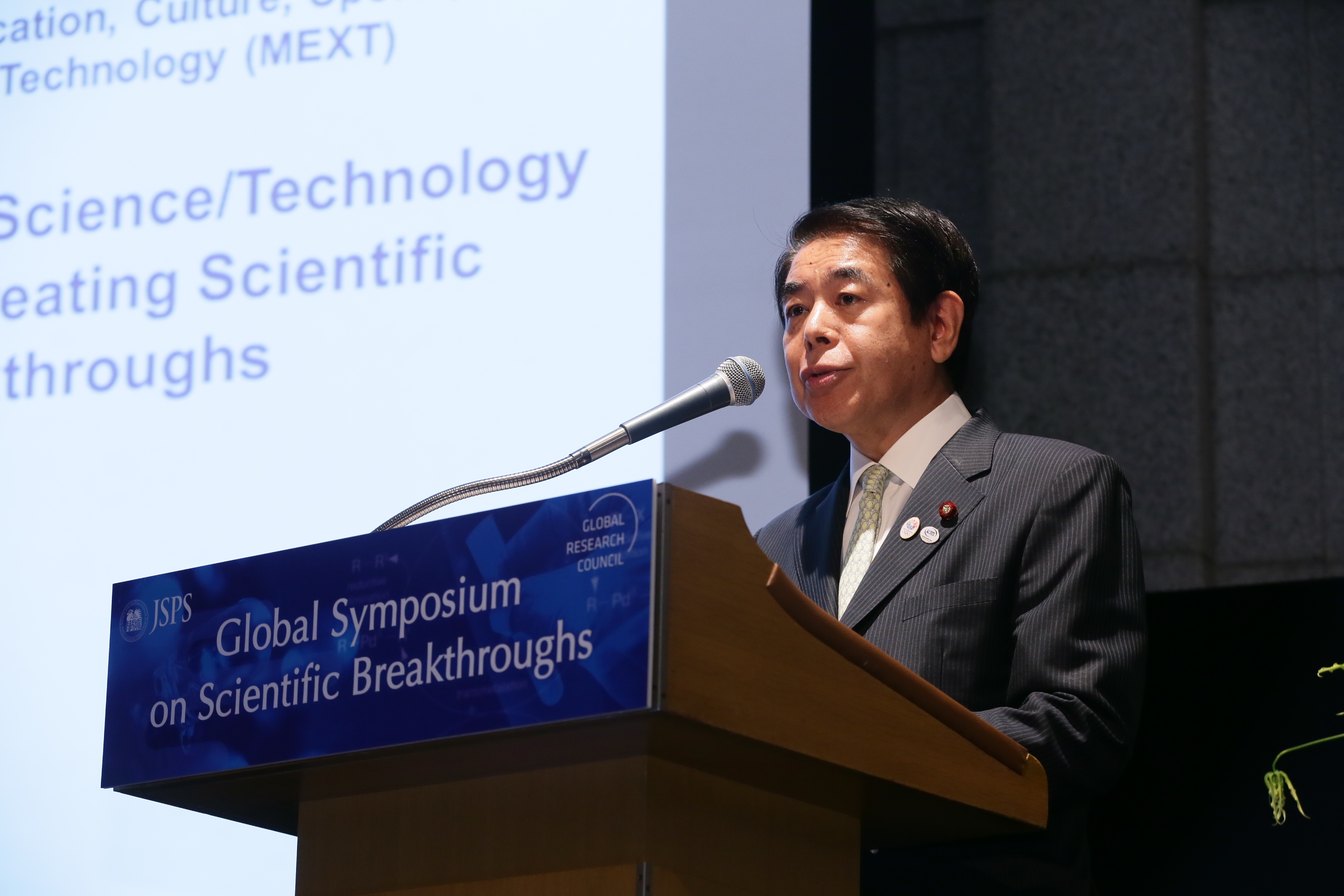
Special Lecture presented by Mr. Hakubun Shimomura Minister of Education, Culture, Sports, Science and Technology (MEXT)
Education and Science / TechnoIogy PoIicy for Creating Scientific Breakthroughs
Hakubun Shimomura Minister of Education, Culture, Sports, Science and Technology
Thank you very much for allowing me to speak here today.
Abenomics, the Abe administration’s economic policy, is showing definite results. We feel scientific breakthroughs are vital for Japan’s continuing growth and our contributions to the global economy and society. Breakthroughs are the key for constant innovation.
Today I would like to speak about two topics regarding the direction of MEXT’s education and science and technology policies from now. These policies will lead to Japan’s growth by creating breakthroughs and spurring innovation.
The first topic is the drastic educational reforms we will carry out from now to respond to the needs of the new era.
Cathy Davidson, a professor at The Graduate School and University Center of The City University of New York made a very telling point: 65 percent of American children entering elementary school in 2011 will end up working in careers that do not even exist now. Michael Osborne of Oxford University estimates that almost 47 percent of the jobs in the United States will likely be computerized within one or two decades. I believe that this disappearance of many of our current jobs will be a problem in not only the United States but in all advanced countries, including Japan.
We live in an age when the genuine ability to learn is vital. This means the ability to solve problems, to create, and to cultivate the sensibility and grace unique to humans. Because of this reality, we will carry out integrated reforms of high school-and-under education, university education, and the university entrance exam system, which connects them.
Among these efforts, we will actively reform national universities, the spearheads of innovation.
The law for reforming university governance went into effect this past April. This means that university presidents can now exercise positive leadership for reforming the way universities are run. National universities must urgently reform themselves. They must change and remake their systems with the aim of advancing scholarship and innovation.
We want universities to become better, based on their own vision. For this, we have built a new framework for providing operating grants to national universities. There are three priority areas for support: one, the fostering of human resources who can meet society’s needs; two, the creation of first-rate educational research hubs and networks in every field; and three, the promotion of world-class research. Based on this reform initiative, the government will provide funds in a clear and focused way to universities that are actively undertaking self-reforms.
Abenomics, the Abe administration’s economic policy, is showing definite results. We feel scientific breakthroughs are vital for Japan’s continuing growth and our contributions to the global economy and society. Breakthroughs are the key for constant innovation.
Today I would like to speak about two topics regarding the direction of MEXT’s education and science and technology policies from now. These policies will lead to Japan’s growth by creating breakthroughs and spurring innovation.
The first topic is the drastic educational reforms we will carry out from now to respond to the needs of the new era.
Cathy Davidson, a professor at The Graduate School and University Center of The City University of New York made a very telling point: 65 percent of American children entering elementary school in 2011 will end up working in careers that do not even exist now. Michael Osborne of Oxford University estimates that almost 47 percent of the jobs in the United States will likely be computerized within one or two decades. I believe that this disappearance of many of our current jobs will be a problem in not only the United States but in all advanced countries, including Japan.
We live in an age when the genuine ability to learn is vital. This means the ability to solve problems, to create, and to cultivate the sensibility and grace unique to humans. Because of this reality, we will carry out integrated reforms of high school-and-under education, university education, and the university entrance exam system, which connects them.
Among these efforts, we will actively reform national universities, the spearheads of innovation.
The law for reforming university governance went into effect this past April. This means that university presidents can now exercise positive leadership for reforming the way universities are run. National universities must urgently reform themselves. They must change and remake their systems with the aim of advancing scholarship and innovation.
We want universities to become better, based on their own vision. For this, we have built a new framework for providing operating grants to national universities. There are three priority areas for support: one, the fostering of human resources who can meet society’s needs; two, the creation of first-rate educational research hubs and networks in every field; and three, the promotion of world-class research. Based on this reform initiative, the government will provide funds in a clear and focused way to universities that are actively undertaking self-reforms.
My second topic is science and technology policy for creating scientific breakthroughs that will contribute to society.
Science and technology can provide new values for society. For this, we must strengthen reforms for spurring academic research and basic research, which are the fountainheads for innovation. By promoting these reforms in an integral way with the overall university reforms, we are aiming to make Japan the world’s most innovation-friendly country.
We are seeing a switch to open innovation, which transcends institutions and national borders. With this as a new norm, we must constantly create and amass high-quality knowledge that is diverse and creative. To do this, we must promote academic research that is based on the freely developed ideas of researchers. And we must foster people who want to find new areas of research and to challenge the new and unknown.
Last year, three Japanese researchers – Isamu Akasaki, Hiroshi Amano, and Shuji Nakamura – won the Nobel Prize in physics. Not giving into failure and working hard, the three achieved great results in producing blue light LEDs.
Professor Shinya Yamanaka’s research on iPS cells also won him a Nobel Prize in 2012. His discovery is now known by many people around the world. MEXT is intensively providing 110 billion yen for iPS research over ten years. Promising results in this field have already been achieved. For example, last year saw the world’s first transplant of a retina using iPS cells.
I want to stress one point. In Japan, we have constantly tried to uncover the potential of academic research and to support this research from the earliest stage, before it captured the world’s spotlight. We believe that providing continuous support for research, without being a slave to short-term results, leads to the creation of genuine innovation.
At MEXT, we are currently reforming our system for Grants-in-Aid for Scientific Research, called KAKENHI. This is Japan’s most competitive research funding, supporting diverse academic research in all fields.
We are completely reviewing all the KAKENHI programs and evaluation methods and will set up a new Global KAKENHI Fund. Through these efforts, we are aiming to create breakthroughs by merging knowledge that transcends sectors, institutions, and national boundaries.
We want to develop the “seeds of innovation” created from the KAKENHI. To do that, we will build mechanisms for the seamless collaboration with “strategic research” to achieve the targets set by the government.
MEXT is developing core research hubs that bring together the strengths of industry, academia, and the government. We are encouraging innovation through the circulation of human resources among these stakeholders.
In particular, innovation for saving energy is a very important field. Calculations show that if LED lighting continues to spread, energy consumption can be reduced by 7 percent. Energy use can be cut by another 7 percent through the higher efficiency provided by the power semiconductors being developed by Professor Amano. MEXT will provide intensive support to young researchers engaged in power semiconductor research. We will also create R&D innovation hubs through industry-academia-government collaboration. The core hub will be at Nagoya University, where Professor Amano is based.
It has been said that the development of super-efficient power semiconductors will take until 2035. We are aiming to develop them ten years ahead of schedule, by 2025.
Lastly, I hope that this symposium will prove fruitful for all those participating, and serve to promote the understanding throughout society of the value and importance of scientific breakthroughs.
Thank you for your attention.
Science and technology can provide new values for society. For this, we must strengthen reforms for spurring academic research and basic research, which are the fountainheads for innovation. By promoting these reforms in an integral way with the overall university reforms, we are aiming to make Japan the world’s most innovation-friendly country.
We are seeing a switch to open innovation, which transcends institutions and national borders. With this as a new norm, we must constantly create and amass high-quality knowledge that is diverse and creative. To do this, we must promote academic research that is based on the freely developed ideas of researchers. And we must foster people who want to find new areas of research and to challenge the new and unknown.
Last year, three Japanese researchers – Isamu Akasaki, Hiroshi Amano, and Shuji Nakamura – won the Nobel Prize in physics. Not giving into failure and working hard, the three achieved great results in producing blue light LEDs.
Professor Shinya Yamanaka’s research on iPS cells also won him a Nobel Prize in 2012. His discovery is now known by many people around the world. MEXT is intensively providing 110 billion yen for iPS research over ten years. Promising results in this field have already been achieved. For example, last year saw the world’s first transplant of a retina using iPS cells.
I want to stress one point. In Japan, we have constantly tried to uncover the potential of academic research and to support this research from the earliest stage, before it captured the world’s spotlight. We believe that providing continuous support for research, without being a slave to short-term results, leads to the creation of genuine innovation.
At MEXT, we are currently reforming our system for Grants-in-Aid for Scientific Research, called KAKENHI. This is Japan’s most competitive research funding, supporting diverse academic research in all fields.
We are completely reviewing all the KAKENHI programs and evaluation methods and will set up a new Global KAKENHI Fund. Through these efforts, we are aiming to create breakthroughs by merging knowledge that transcends sectors, institutions, and national boundaries.
We want to develop the “seeds of innovation” created from the KAKENHI. To do that, we will build mechanisms for the seamless collaboration with “strategic research” to achieve the targets set by the government.
MEXT is developing core research hubs that bring together the strengths of industry, academia, and the government. We are encouraging innovation through the circulation of human resources among these stakeholders.
In particular, innovation for saving energy is a very important field. Calculations show that if LED lighting continues to spread, energy consumption can be reduced by 7 percent. Energy use can be cut by another 7 percent through the higher efficiency provided by the power semiconductors being developed by Professor Amano. MEXT will provide intensive support to young researchers engaged in power semiconductor research. We will also create R&D innovation hubs through industry-academia-government collaboration. The core hub will be at Nagoya University, where Professor Amano is based.
It has been said that the development of super-efficient power semiconductors will take until 2035. We are aiming to develop them ten years ahead of schedule, by 2025.
Lastly, I hope that this symposium will prove fruitful for all those participating, and serve to promote the understanding throughout society of the value and importance of scientific breakthroughs.
Thank you for your attention.