


International Prize for biology
2025 Presentation Ceremony, Acceptance Address, Selection Process, Commemorative Symposium
Presentation Ceremony
for the 2025 International Prize for Biology was held
in the presence of Their Imperial Highnesses the Crown Prince and Crown Princess Akishino on December 17, 2025
for the 2025 International Prize for Biology was held
in the presence of Their Imperial Highnesses the Crown Prince and Crown Princess Akishino on December 17, 2025
41st Prize Recipient
Prof. Giacomo Rizzolatti Emeritus Professor, Full Professor of Human Physiology – University of Parma, Italy
Prof. Giacomo Rizzolatti Emeritus Professor, Full Professor of Human Physiology – University of Parma, Italy

The award ceremony was held in the presence of Their Imperial Highnesses Prince and Princess Akishino.
On December 17, 2025, the presentation ceremony for the 2025 International Prize for Biology was held at The Japan Academy in the presence of Their Imperial Highnesses the Crown Prince and Crown Princess Akishino, Mr. UNO Yoshimasao, Special Advisor to the Prime Minister of Cabinet Office, and Mr. MATSUMOTO Yohei, Minister of Education, Culture, Sports, Science and Technology (MEXT).
At the ceremony, Prof. Giacomo Rizzolatti was presented the Prize of 10-million yen and a medal by Dr. FUJIYOSHI Yoshinori, Chair of the International Prize for Biology Committee, along with an Imperial gift from the Crown Prince Akishino.
Following an address offered by the Crown Prince Akishino, congratulatory messages were delivered by Prime Minister TAKAICHI Sanae (read by Mr. UNO) and MEXT Minister Mr. MATSUMOTO Yohei. The ceremony concluded with an acceptance address from Prof. Rizzolatti.
After the ceremony, a reception to honor the Prize recipient was held in the presence of the Crown Prince and Princess Akishino.
At the ceremony, Prof. Giacomo Rizzolatti was presented the Prize of 10-million yen and a medal by Dr. FUJIYOSHI Yoshinori, Chair of the International Prize for Biology Committee, along with an Imperial gift from the Crown Prince Akishino.
Following an address offered by the Crown Prince Akishino, congratulatory messages were delivered by Prime Minister TAKAICHI Sanae (read by Mr. UNO) and MEXT Minister Mr. MATSUMOTO Yohei. The ceremony concluded with an acceptance address from Prof. Rizzolatti.
After the ceremony, a reception to honor the Prize recipient was held in the presence of the Crown Prince and Princess Akishino.
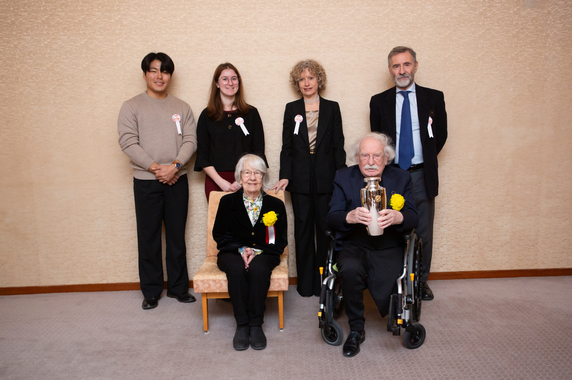
Prof. Rizzolatti and his family.
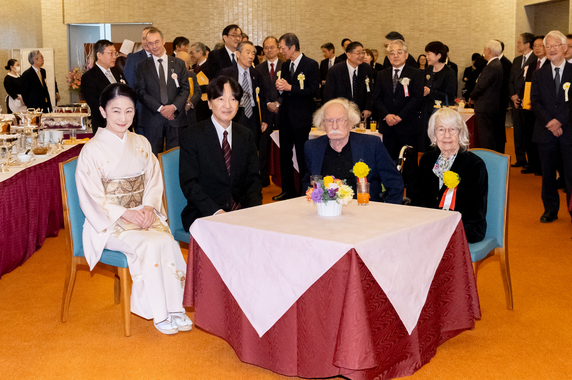
Reception
Your Imperial Highnesses, Your Excellencies, Ladies and Gentlemen,
I am deeply honored and delighted to receive the forty-first International Biology Prize, this year awarded in the field of neurobiology.
The Selection Committee, has recognized my work for the discovery of mirror neurons. These neurons represent the neural basis for understanding others, and have had a profound impact on cognitive neuroscience.
At the outset, I would like to share a few words with you on how we discovered these neurons, as well as the earlier experiments that paved the view to this discovery.
The story began with a grant from the Human Frontier Science Program, awarded to a team consisting of Marc Jeannerod, Michael Arbib, Hideo Sakata, and myself. The grant provided us not only financial support, very generous, but also the opportunity to periodic meetings to their own home countries of the members. Thanks to this program, I visited Japan several times and became friend, besides Hideo, with several distinguished Japanese scientists like Jun Tanji, Atsushi Iriki, and Akira Murata. Hideo also accompanied my wife and myself to climb to Mount Fuji. It was a great experience.
Back to science, the outcome of our Human Frontier collaboration was a paper on the neural mechanisms underlying grasping actions. This paper remains fundamental in this field. Meanwhile, with three young scientists from Parma -Fadiga, Fogassi, and Gallese – we continued studying the premotor cortex of monkeys. We adopted an ethological approach: which means to play with the monkey rather to examine only the physical properties of the neurons.
The first significant finding from these studies was that the premotor cortex does not encode movements defined as joint displacement, but rather the goal of a motor act, as for example, reaching, grasping and so on.
The most exciting discovery, however, came when we found neurons that discharged both when the monkey performed a motor act and when it observed the same motor act performed by another individual. I was astonished. I confess you that I was very scared of this finding. I was afraid that it may be an artifact. We performed, therefore, a very careful verification for years. Finally, 4 years after the original discovery we published our findings on the Brain, one of the most prestigious journals of neurology, and we named these neurons, mirror neurons.
The concept of mirror neurons was enthusiastically received by the neuroscientific community, especially after neuroimaging studies allowed us to demonstrate the same mechanism also in humans.
A fascinating question was of course the function of this mechanism. Our original hypothesis was that it represents the neural basis of imitation. This turned out to be true, but not sufficiently wide. Mirror neurons have been found, since our discovery, also in many animal species -birds, mice, rats, marmosets, and bats. Most of these species cannot imitate in proper sense. The accepted hypothesis today is that the mirror mechanism is an ancient neural mechanism that allows individuals to understand the actions of others by mapping observed actions on their own motor representations. This type of understanding has been termed by us ''understanding from the inside. “
An important step in comprehending the mirror mechanism came with the realization that it is involved not only in understanding of '' cold'' actions, grasping for example, but also in actions with emotional content. The first demonstration of this role concerned the neural basis of disgust. Subsequently many experiments showed that the same mechanism is also at basis of understanding of other emotions like fear, joy and anger.
Finally, the possibility to activate the motor system through the mirror mechanism led to important clinical applications. Imagine a patient who has a limb blocked by plaster cast and cannot move his /her arm. When the cast is removed, the patient's movements are impaired. The classical interpretation is that this occurs because the muscles become weak as a consequence of immobilization. This is partially true. Actually, and more importantly, what happens is that the motor program that control arms action is depressed. When the patient tries to move his/her arm, he cannot, because of arm motor program depression. If, however, the impaired action is presented via vision, the depressed motor program became alive again, and the patient can move immediately. The possibility of improving the impaired movement, via mirror mechanism, had great success. Now this technique, known as Action Observation Therapy, is used not only in orthopedic rehabilitation but also in neurological conditions such as stroke, Parkinson’s disease, and multiple sclerosis.
In conclusion, receiving the International Biology Prize greatly encourages me and my co-workers to deepen our investigations into the mirror mechanism and to explore new clinical applications of this remarkable neural system.
Thank you.
I am deeply honored and delighted to receive the forty-first International Biology Prize, this year awarded in the field of neurobiology.
The Selection Committee, has recognized my work for the discovery of mirror neurons. These neurons represent the neural basis for understanding others, and have had a profound impact on cognitive neuroscience.
At the outset, I would like to share a few words with you on how we discovered these neurons, as well as the earlier experiments that paved the view to this discovery.
The story began with a grant from the Human Frontier Science Program, awarded to a team consisting of Marc Jeannerod, Michael Arbib, Hideo Sakata, and myself. The grant provided us not only financial support, very generous, but also the opportunity to periodic meetings to their own home countries of the members. Thanks to this program, I visited Japan several times and became friend, besides Hideo, with several distinguished Japanese scientists like Jun Tanji, Atsushi Iriki, and Akira Murata. Hideo also accompanied my wife and myself to climb to Mount Fuji. It was a great experience.
Back to science, the outcome of our Human Frontier collaboration was a paper on the neural mechanisms underlying grasping actions. This paper remains fundamental in this field. Meanwhile, with three young scientists from Parma -Fadiga, Fogassi, and Gallese – we continued studying the premotor cortex of monkeys. We adopted an ethological approach: which means to play with the monkey rather to examine only the physical properties of the neurons.
The first significant finding from these studies was that the premotor cortex does not encode movements defined as joint displacement, but rather the goal of a motor act, as for example, reaching, grasping and so on.
The most exciting discovery, however, came when we found neurons that discharged both when the monkey performed a motor act and when it observed the same motor act performed by another individual. I was astonished. I confess you that I was very scared of this finding. I was afraid that it may be an artifact. We performed, therefore, a very careful verification for years. Finally, 4 years after the original discovery we published our findings on the Brain, one of the most prestigious journals of neurology, and we named these neurons, mirror neurons.
The concept of mirror neurons was enthusiastically received by the neuroscientific community, especially after neuroimaging studies allowed us to demonstrate the same mechanism also in humans.
A fascinating question was of course the function of this mechanism. Our original hypothesis was that it represents the neural basis of imitation. This turned out to be true, but not sufficiently wide. Mirror neurons have been found, since our discovery, also in many animal species -birds, mice, rats, marmosets, and bats. Most of these species cannot imitate in proper sense. The accepted hypothesis today is that the mirror mechanism is an ancient neural mechanism that allows individuals to understand the actions of others by mapping observed actions on their own motor representations. This type of understanding has been termed by us ''understanding from the inside. “
An important step in comprehending the mirror mechanism came with the realization that it is involved not only in understanding of '' cold'' actions, grasping for example, but also in actions with emotional content. The first demonstration of this role concerned the neural basis of disgust. Subsequently many experiments showed that the same mechanism is also at basis of understanding of other emotions like fear, joy and anger.
Finally, the possibility to activate the motor system through the mirror mechanism led to important clinical applications. Imagine a patient who has a limb blocked by plaster cast and cannot move his /her arm. When the cast is removed, the patient's movements are impaired. The classical interpretation is that this occurs because the muscles become weak as a consequence of immobilization. This is partially true. Actually, and more importantly, what happens is that the motor program that control arms action is depressed. When the patient tries to move his/her arm, he cannot, because of arm motor program depression. If, however, the impaired action is presented via vision, the depressed motor program became alive again, and the patient can move immediately. The possibility of improving the impaired movement, via mirror mechanism, had great success. Now this technique, known as Action Observation Therapy, is used not only in orthopedic rehabilitation but also in neurological conditions such as stroke, Parkinson’s disease, and multiple sclerosis.
In conclusion, receiving the International Biology Prize greatly encourages me and my co-workers to deepen our investigations into the mirror mechanism and to explore new clinical applications of this remarkable neural system.
Thank you.
On behalf of the Selection Committee on the 41st International Prize for Biology, I wish to report on the procedure taken by our Committee in the process of selecting this year’s Prize recipient.
The Committee was composed of 20 members, including four researchers from overseas.
The award field of this year’s Prize was Neurobiology. To solicit nominations of suitable candidates, the Committee first sent 1,508 requests for nominations to universities, research institutes, academic societies, and international scholarly institutions both in Japan and abroad. In response, 60 letters of nomination were received. After excluding duplicate nominations, the total number of nominees was 46 individuals from 18 countries and regions. Next, the Committee met a total of five times to conduct a careful and thorough evaluation of the nominated candidates.
As a result of this review process, the Committee recommended Professor Giacomo Rizzolatti to the Committee on the International Prize for Biology as the recipient of the 41st International Prize for Biology.
Professor Rizzolatti has pursued his research at the University of Pisa and the University of Parma, and he continues to engage in research and education as Professor Emeritus at the University of Parma.
Professor Rizzolatti is internationally renowned as the discoverer of mirror neurons and the proponent of the mirror mechanism. He has published a large volume of scientific papers on these and other of his research findings. His discovery of mirror neurons and the mirror mechanism gave birth to “social neuroscience,” an entirely new field in systems and cognitive neuroscience. As a discipline, social neuroscience explores the neural structures underlying the understanding of others’ actions.
With regard to the human mirror mechanism, Professor Rizzolatti used brain-imaging techniques to show that specific regions of the brain are activated when individuals observe the actions of others. He also showed that the mirror mechanism is involved in understanding the emotions of others.
Through his discovery of mirror neurons, Professor Rizzolatti elucidated the neural basis for understanding others at various levels, including behavior. Whereas neuroscience research had previously focused on the individual, the discovery of mirror neurons expanded the domain to include relationships among multiple individuals—in other words, “society.” This body of Professor Rizzolatti’s work has made a major contribution to the subsequent advancement of neuroscience as a whole.
The impact of Professor Rizzolatti’s work on the progress of neuroscience has been of extraordinary significance, while fully satisfying all of the review criteria for this Prize. It fits within the Award field, embodies originality, exerts influence on the field, and contributes to biology as a whole.
Based on the recommendation of the Selection Committee, the Committee on the International Prize for Biology deliberated and decided to confer the 41st International Prize for Biology upon Professor Giacomo Rizzolatti.
This concludes my report on the review process.
The Committee was composed of 20 members, including four researchers from overseas.
The award field of this year’s Prize was Neurobiology. To solicit nominations of suitable candidates, the Committee first sent 1,508 requests for nominations to universities, research institutes, academic societies, and international scholarly institutions both in Japan and abroad. In response, 60 letters of nomination were received. After excluding duplicate nominations, the total number of nominees was 46 individuals from 18 countries and regions. Next, the Committee met a total of five times to conduct a careful and thorough evaluation of the nominated candidates.
As a result of this review process, the Committee recommended Professor Giacomo Rizzolatti to the Committee on the International Prize for Biology as the recipient of the 41st International Prize for Biology.
Professor Rizzolatti has pursued his research at the University of Pisa and the University of Parma, and he continues to engage in research and education as Professor Emeritus at the University of Parma.
Professor Rizzolatti is internationally renowned as the discoverer of mirror neurons and the proponent of the mirror mechanism. He has published a large volume of scientific papers on these and other of his research findings. His discovery of mirror neurons and the mirror mechanism gave birth to “social neuroscience,” an entirely new field in systems and cognitive neuroscience. As a discipline, social neuroscience explores the neural structures underlying the understanding of others’ actions.
With regard to the human mirror mechanism, Professor Rizzolatti used brain-imaging techniques to show that specific regions of the brain are activated when individuals observe the actions of others. He also showed that the mirror mechanism is involved in understanding the emotions of others.
Through his discovery of mirror neurons, Professor Rizzolatti elucidated the neural basis for understanding others at various levels, including behavior. Whereas neuroscience research had previously focused on the individual, the discovery of mirror neurons expanded the domain to include relationships among multiple individuals—in other words, “society.” This body of Professor Rizzolatti’s work has made a major contribution to the subsequent advancement of neuroscience as a whole.
The impact of Professor Rizzolatti’s work on the progress of neuroscience has been of extraordinary significance, while fully satisfying all of the review criteria for this Prize. It fits within the Award field, embodies originality, exerts influence on the field, and contributes to biology as a whole.
Based on the recommendation of the Selection Committee, the Committee on the International Prize for Biology deliberated and decided to confer the 41st International Prize for Biology upon Professor Giacomo Rizzolatti.
This concludes my report on the review process.
To mark the award to Prof. Rizzolatti, a Commemorative Symposium for the 41st International Prize for Biology, "Current Breakthrough Topics in Neurobiology" was held on December 20 and 21, 2025 in Tokyo, co-organized by The University of Tokyo and the Japan Society for the Promotion of Science.
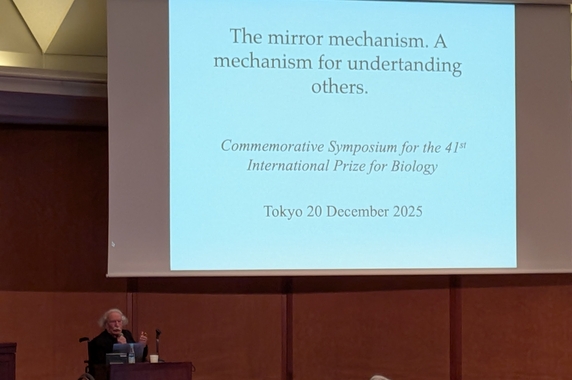
Symposium at Ito International Research Center
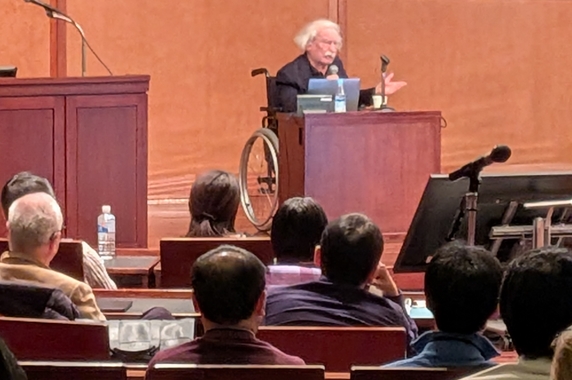
Lecture by Prof. Rizzolatti